
NONPROFIT TECHNOLOGY
Turn technology into a strategic advantage — not a source of risk or overwhelm. These briefings and experts help leaders use digital tools to strengthen operations, streamline communication, protect data, and guard against fraud.
Explore valuable guidance on choosing the right software, automating workflows, securing donor and client information, managing compliance, and building a more efficient tech stack. Our nonprofit technology experts break down what matters most: from CRM systems and AI tools to cybersecurity, backups, and fraud prevention.
Whether you’re selecting your first platform, improving internal processes, responding to a data breach, or preparing your team for digital transformation, these sessions make technology accessible, mission-driven, and safe — so your organization can operate with confidence and keep the focus on impact.
The Most Recent Nonprofit Technology Expert Sessions

Where does AI genuinely save time for nonprofits—and where does it create new risks? Buu-Linh Tran of JMT Consulting and Torbjorn Nilsen of DATABASICS examine how AI can strengthen nonprofit finance operations without surrendering data security, human judgment, or organizational control.

AI for nonprofit staff burnout is becoming one of the most important operational conversations in the sector. This episode explores how nonprofits can use AI to reduce staff burnout, protect institutional knowledge, and build smarter internal systems. Ben Hays of Your Part-Time Controller explains why burnout belongs in boardroom conversations about risk, finance, staffing, and mission sustainability.

AI in nonprofit fundraising strategy is transforming how organizations operate—but using it incorrectly can damage donor relationships and trust. In this conversation, Katie Gaston of Bloomerang opens the box with practical guidance on how to use AI effectively while avoiding the most common pitfalls.
Nonprofit professionals are increasingly turning to AI tools for donor research, reporting, and communications. The opportunity is clear: faster workflows, better insights, and increased capacity. But as Katie explains, AI is not a replacement for human judgment—it’s a tool to enhance it. “AI should be a supportive arm… but it should never replace your judgment as a fundraiser.”
From donor asks to personalized stewardship, the human connection remains at the core of successful fundraising. AI can prepare you for meetings, surface insights, and even recommend strategies—but it cannot replicate the emotional intelligence required in critical moments.
This episode also addresses key operational risks. Sending AI-generated content without review, relying too heavily on automated insights, and failing to maintain clean data can all create serious challenges. As Katie reminds us, “The quality of your data is what AI will know—garbage in, garbage out.”

This episode explores how nonprofits can fix fragmented data systems by centralizing information, improving reporting, and building scalable infrastructure that supports growth and better decision-making. A strong nonprofit data management strategy is no longer optional—it’s essential for scaling impact, improving reporting, and saving valuable staff time.
Cherry Yang, CEO of Claribase and an award-winning Airtable consultant, shares how nonprofits can move from fragmented systems and spreadsheet overload to centralized, scalable data operations. If your team is constantly switching tools, copying and pasting data, or struggling to produce reports, this conversation offers a clear path forward.
Cherry explains why most nonprofit systems fail: they operate in silos. Fundraising platforms, program data, financial tools, and spreadsheets often live separately—creating inefficiencies and increasing risk. As she notes, “People end up doing a lot of copy and pasting… and it just doesn’t work. It’s not efficient, and people waste so much time.”
Instead, she advocates for centralized data systems that connect teams, automate workflows, and provide real-time dashboards for leadership. With the right structure, nonprofits can eliminate manual processes, reduce errors, and give decision-makers immediate access to insights.

A visit with Doug Chapiewsky, CEO & President of Kanso Software, and Cameron Bowman, CAAS Solutions Consultant at JMT Consulting, for a fast-moving, systems-first conversation on one thing every nonprofit runs on: trustworthy data.
Cameron frames the moment we’re in as “the golden age of software”—more tools, more dashboards, more integrations, and more AI than ever before. But that abundance comes with a price: fragmented systems, duplicated entries, and competing versions of the same truth. His fix is refreshingly operational. Data integrity isn’t a buzzword; it’s a checklist: accurate, complete, consistent across systems, timely, and traceable/auditable. When any one of those breaks, nonprofits pay for it in grant compliance headaches, restricted-fund confusion, audit stress, and board decisions made on shaky information.
Doug brings the lens of housing—where data errors don’t just create inconvenience; they disrupt funding, compliance, and real people’s stability. Kanso’s mission is to simplify a highly regulated, high-stakes domain where sensitive data is everywhere and staffing capacity is often thin. As Doug puts it, “Trust outweighs technology… and if we don’t have that trust, it really gets right to your mission.” The episode drills into the reality that single-vendor “one system does it all” is fading fast; modern organizations operate in an ecosystem. That’s why both speakers prioritize open systems paired with serious guardrails—especially when handling social security numbers, income data, and family composition.
The conversation turns tactical with a Business Process Review (BPR): mapping where data originates, how it moves, who owns it, what controls exist, and where manual workarounds (shadow spreadsheets, email approvals, offline tracking) weaken audit trails and invite risk. Cameron lands a line every operations leader should post near their monitor: “Technology will amplify your process. It won’t correct your misaligned workflows.”
Finally, the duo urge nonprofits to build a cadence—monthly, quarterly, at least annually—to revisit processes, configuration, and integrations as funding rules, reporting needs, staff, and tech keep shifting. The message is clear: clean data isn’t a finance luxury—it’s a mission accelerant.
#TheNonprofitShow #NonprofitTechnology #DataIntegrity

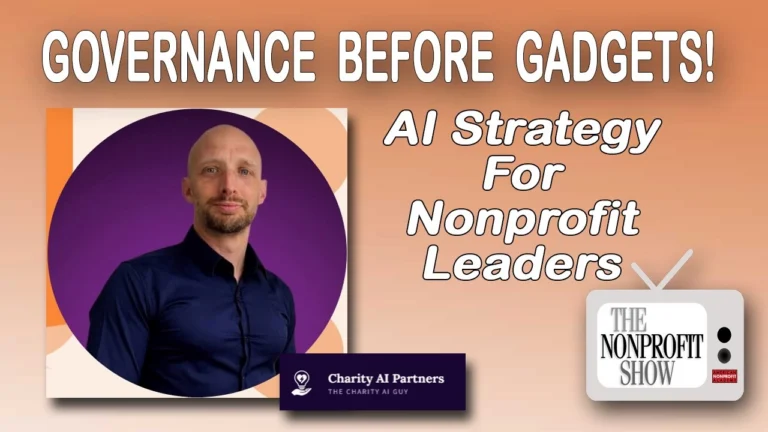
AI isn’t a “someday” conversation for nonprofits anymore it’s a right-now operational decision with governance, risk, and staff behavior at the center. Joshua Peskay, Co-Founder of Meet the Moment, joined Julia C. Patrick to talk about the practical reality nonprofits are facing: AI adoption is already happening inside your organization whether leadership has planned for it or not.
Joshua frames the moment with a clear warning and a workable path forward. Too many nonprofits, he says, are bumping into “governance immaturity” the missing pieces that turn AI from a productivity boost into a liability. Think policies, staff learning, data classification and handling, and vendor risk review. Instead of debating whether AI is allowed, Joshua urges leaders to start by accepting the current state and then managing it with intention. As he puts it, “Artificial intelligence is happening and it is happening incredibly fast… the water is coming down the mountain.”
The duo reinforce what many executives have observed: when organizations ban AI, staff still use it they just do it quietly, creating silos and exposure. Joshua connects that to a familiar cybersecurity pattern: shadow IT. People work around constraints to get the job done, especially in a sector that’s under-resourced, remote, and mission-urgent.
The forward-looking takeaway is refreshingly actionable: start with the AI tools already inside your protected environment. If your nonprofit runs on Microsoft 365 or Google Workspace, use Copilot, Gemini, or NotebookLM as your baseline so staff can work with guardrails. For anything outside that ecosystem, require a business case and a review process. Then, build a learning culture where staff share what’s working, what’s failing, and what’s safe.
Joshua also brings urgency from the risk landscape, noting nonprofits are attractive targets because of sensitive data and typically weaker security.
#TheNonprofitShow #NonprofitManagement #AIgovernance
FOR THE BUSINESS OF NONPROFITS
POWER SEARCH OUR SITE
Search 1,500+ nonprofit business videos, articles, and learning resources.