
Nonprofit Boards And Planning
Build a board that leads with purpose, accountability, and clarity. This collection of expert-led video sessions gives nonprofit leaders and board members the tools to strengthen governance, support executive leadership, and keep mission and management aligned.
Explore core responsibilities such as fiduciary and legal duties, financial oversight, policy-making, conflict of interest management, and executive evaluation. Learn how to recruit and retain the right board members, clarify roles, and create a culture of shared ownership and strategic discipline.
These lessons also dive into the essentials of planning—from long-term vision and performance metrics to real-world models for board–staff alignment and decision-making. Whether you’re structuring your first board or elevating the effectiveness of an established one, this content offers actionable frameworks to help your organization govern responsibly and lead with confidence.
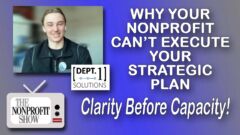
If your nonprofit’s strategic plan is sitting on a shelf instead of driving results, this conversation is your wake-up call. Dylan Bassett, Principal and Founder of Department 1 Solutions, challenges a deeply ingrained habit across the sector: setting ambitious goals without first understanding operational capacity.
Dylan makes it clear—most nonprofit plans fail not because of poor intentions, but because they are disconnected from the realities of staff bandwidth, systems, and workflows. As he explains, “A lot of nonprofit strategic plans are too big for the team that’s executing them.” That disconnect creates frustration, burnout, and ultimately stalled progress.
Instead of starting with lofty goals, Dylan urges organizations to flip the model. Begin by assessing what your team and technology can actually support today. Then identify the gap between current capacity and future ambitions. That gap becomes the real work—where systems, processes, and people must align.
A major takeaway? Many nonprofits already have the tools they need but are underutilizing them. Rather than rushing to purchase new platforms, leaders should first uate how existing systems can be better configured and adopted. This approach not only saves money but also strengthens internal efficiency.
Dylan also emphasizes turning strategy into a daily habit. By breaking large goals into smaller, measurable actions, organizations can maintain momentum, build team confidence, and create regular opportunities for progress. As he shares, “The success of success is the sum of small efforts repeated day in and day out.”
This is more than a planning conversation—it’s a call to rethink how your organization operates. Bring your team into the process. Align your tools with your workflows. And most importantly, create a roadmap that your staff can actually execute.
If your nonprofit is ready to move from planning to performance, this episode is your next step.
#TheNonprofitShow #NonprofitStrategy #OperationalExcellence
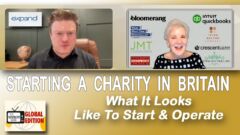
The Nonprofit Show launches its Global Edition with cohosts Julia C. Patrick and Matthew Murray (CEO, Expand PR / Expand Consultancy), taking listeners inside what it really looks like to start and operate a charity/NGO in the United Kingdom—and why global expansion is as much a business decision as it is a mission decision.
Matthew opens with the on-the-ground reality that “every culture has its own nuances… laws and rules,” and that expanding beyond your home country requires leaders to respect local norms, donor behaviors, and governance expectations. The conversation quickly turns practical: Do Brits give? Matthew says yes—substantially—while noting economic pressures have shifted donor patterns. He also explains a key difference for revenue strategy: the UK doesn’t mirror U.S.-style donor tax deductions, but it does offer Gift Aid, where government adds funding to eligible donations. As Matthew describes it, “25 pence for every pound donated,” meaning a £100 gift can become £125 for the charity—an important lever for fundraising planning, messaging, and cash forecasting.
On governance and transparency, the UK’s Charity Commission functions as a dedicated regulator for charities. Matthew emphasizes the public nature of filings and the reputational impact of being late or sloppy with reporting—because funders, partners, and major donors look. In the UK, board members are typically called trustees, are usually unpaid, and cannot be paid for the trustee role itself (though they may be compensated for a separate job). For organizations with global ambitions, Matthew shares a strategic advantage: non-UK residents can serve as trustees in Britain, which can simplify governance when launching a UK-based entity.
The global discussion also contrasts donor culture. Matthew suggests UK donors may give differently than U.S. donors—often less driven by “momentary adrenaline” and more oriented toward longer-term loyalty—reinforcing the value of relationship, credibility, and consistency. Julia adds a caution for international leaders: expansion fails fast when it arrives with a “we’ll fix you” mindset. The Global Edition’s promise is clear: practical global learning that helps nonprofit executives expand responsibly, protect integrity, and build durable support across borders.
#NonprofitBusiness #GlobalPhilanthropy #TheNonprofitShow

Boards get plenty of attention in the nonprofit sector, but this lively conversation zooms in on the role that can make or break governance performance: the board chair. Alisa Chatinsky, CEO of NonprofitSuccess.org, talks about what strong chair leadership really looks like—and why so many organizations treat the position like an honorific instead of a job with real operational and strategic responsibilities.
Alisa shares that after decades in nonprofit leadership and nearly 14 years consulting and serving in interim roles, she stepped into board service again and was immediately asked to chair. That experience sparked a practical question: How many chairs are actually set up to succeed? Her conclusion is simple and business-minded: “Because when a board chair is strong, the board is strong and the organization is strong.” She explains that boards often “recruit” chairs by minimizing expectations, which leads to sloppy meeting execution, confused roles, and underused talent.
The conversation becomes a working blueprint for better governance. Alisa outlines what effective chairs do: run meetings with purpose and time discipline, keep the board out of day-to-day management, build consensus, listen well, and handle conflict without letting it hijack the mission. She emphasizes governance infrastructure that supports decision-making: a governance calendar, clear expectations, job descriptions, consent agendas, dashboards, and space for generative discussions that move the organization forward.
A standout lesson is the connection between life cycle stage and board behavior. As organizations mature, the board’s work must mature too—and that can mean changing how meetings operate and what board members are willing (or able) to contribute. Alisa also advocates for board mentoring and orientation that includes real business essentials (budget, program allocations, financial results), so members can represent the organization confidently in the community. As she puts it, “We reinvest our profits in our mission.”
The episode closes with her “Five-Star Board Chair” master class concept, pairing training with coaching and a real board meeting uation—designed to build leadership capacity that improves governance, accountability, and long-term organizational strength.
#BoardGovernance #NonprofitLeadership #TheNonprofitShow
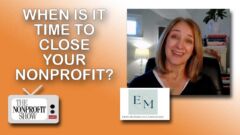
Sunsetting a nonprofit is one of the most difficult decisions a board and executive team can face. Erin McPartlin, Principal of Erin McPartlin Consulting, guides leaders through the strategic and compassionate realities of organizational closure.
Host Julia Patrick opens the conversation by acknowledging the emotional weight of the topic. Closing an organization can feel like failure. Yet Erin reframes the discussion: sometimes the healthiest business decision is an intentional ending. Whether an organization has achieved its mission, become operationally stagnant, or reached financial unsustainability, the question is not just when to close—but how to do so responsibly.
Erin outlines three common scenarios: mission accomplished, operational decline with weak infrastructure, and full financial unsustainability. In many cases, boards wait too long to confront the truth. “If you get to that point where you're now saying, we need to look at should we stay open or not, you're probably past the decision point,” she explains. That delay often stems from intermittent success—a returning donor, a new grant, a compelling impact story—that keeps leadership hoping for a turnaround.
From a governance standpoint, Erin emphasizes four pillars: people, communication, finance, and risk. Boards must fully engage, understand cash flow, assess liabilities, calculate burn rate, and uate runway. The most important question becomes, “What is the cost of our inaction?”
Rather than allowing an abrupt collapse—locked doors and shocked staff—Erin advocates for a structured 4–6 month minimum runway. This deliberate process allows nonprofits to respect employees, honor donor commitments, manage restricted funds, and protect community trust.
The episode closes on a powerful idea: the “elegant ending.” By planning intentionally, nonprofits can celebrate their impact, transfer knowledge, mentor peer organizations, and potentially redistribute remaining funds to aligned missions. “It’s preserving the public perception and preserving the positivity in the work that this organization did,” Erin shares.
Closing well is not defeat. It is stewardship.
#NonprofitManagement #BoardGovernance #TheNonprofitShow

Jeffrey R. Wilcox, President and Chief Learning Curator of Third Sector Company, and Nancy Bacon of Nancy Bacon Consulting—provide a timely conversation on interim leadership as a smart business move for nonprofits.
Nancy shares the findings from their recently completed report on Interim Leadership and how it was built through deep listening—town halls, surveys, and focus groups with interim experts across North America—to capture what the field is becoming. The result: a sector-wide definition that positions interim leadership as an intentional, mission-centered intervention at a pivotal moment—built to stabilize operations, guide people through change, and set up the next leader for success.
Jeffrey makes the business case with unmistakable clarity: “Interim is an investment. It is not an expense.” Rather than a temporary human resource fix, the work addresses a major risk facing nonprofits: executive attrition and leadership transitions that aren’t planned. Boards that treat a transition like an emergency hire often trade speed for stability—then pay for it later in culture strain, staff churn, and stalled momentum.
The conversation lifts the role of language in board decision-making. Both guests emphasize that clear expectations reduce fear and prevent “accidental interims” created by rushed succession. Jeffrey shares a simple framework interims consistently bring: clarity, capacity, and confidence—so boards can move forward with shared reality instead of conflicting perceptions.
Finally, the episode widens the lens: interim leadership is expanding beyond coastal hubs, accelerated by COVID-era shifts and virtual capacity, allowing experienced leaders to support rural and smaller communities that need strong nonprofit operations the most.
If your organization is thinking about succession—or avoiding it—this conversation offers a practical, mission-forward way to treat leadership change as a moment to strengthen the business engine behind the mission.
#TheNonprofitShow #NonprofitManagement #SuccessionPlanning
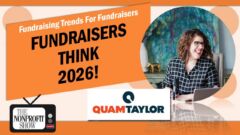
What does it take for a nonprofit to grow from “we’re getting by” to “we’re building a real engine for impact”? In this energizing conversation, Julia Patrick sits down with Sherry Quam Taylor of Quam Taylor to talk about what nonprofit leaders should truly focus on in 2026 if they want sustainable, strategic revenue growth.
Sherry starts with a bold challenge: stop letting scarcity run the organization. Not as a motivational poster idea, but as a practical leadership decision. Her favorite starting place is a deceptively simple exercise: take the strategic plan and price it out honestly. Not the “squeak by” version. The real version. Reserves. Living wage salaries. The marketing role you never replaced. Staff development. The tech you keep postponing. When leaders finally put the full need on paper, something shifts from fear to possibility, because the organization can now align revenue goals to an actual plan.
From there, Sherry calls out one of the biggest growth blockers in the sector: trying random tactics instead of committing to a planned strategy. As she puts it, “If we align our hours to dollars… there’s actually a math equation that gets to that.” That’s the business of nonprofits in one sentence: staffing, activities, and fundraising effort must match the revenue destination.
Then she brings it home with a refreshing reminder that modern fundraising still wins through relationships. Not stiff, over engineered emails and performative professionalism, but real human connection. Sherry has a simple mantra her clients keep on sticky notes: “Talk like a human.” She explains that both funders and nonprofits want the same thing a genuine conversation with the people behind the work. In a world where messages all start to sound the same, authenticity becomes a competitive advantage.
Finally, she makes a case for something too many organizations avoid: asking for help and budgeting for it. Growth requires investment in expertise, capacity, and support systems, and boards should be champions of that, not roadblocks.
If your nonprofit is ready to fund the plan you actually want, not the one you can barely afford, this episode will leave you with momentum and a smarter path forward.
#TheNonprofitShow #NonprofitManagement #FundraisingStrategy
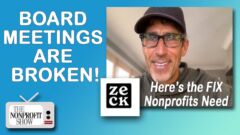
Every nonprofit says they want board meetings that are strategic, energizing, and worth everyone’s time. And yet… so many board meetings still feel like a quarterly endurance test: long decks, last-minute prep, and a live meeting that turns into a read-aloud.
We visit with Robert Wolfe, CEO and founder of Zeck—to reimagine how boards and leadership teams communicate—because meeting design is not a “nice-to-have.” It’s a capacity issue. When leaders burn 100–150 hours building decks and board members struggle to engage with clunky PDFs, the mission pays the price.
Robert shares the origin story behind Zeck, built from his experience as an operator who lived the board-meeting grind firsthand. He’s refreshingly blunt about the tools we still tolerate: “No one in the world would wake up in the morning and read their news in a PowerPoint slide deck.” And he makes a bold comparison that lands for any executive team trying to modernize: “Zeck is to board meetings as DocuSign is to signing your contracts and agreements.”
The conversation focuses on what matters for nonprofit business operations: saving staff time, boosting board participation, and moving governance work out of the live meeting and into smarter pre-work. Robert walks through practical innovations like pre-voting (so approvals don’t eat the first 45 minutes), analytics that show engagement (and create healthy peer pressure), and AI features that support content creation—without turning every boardroom comment into a permanent artifact.
If your board meetings create dread, drag down morale, or result in rubber-stamp decisions, this episode offers a modern path forward—one that respects time, improves decision-making, and helps leaders stay focused on outcomes, not formatting.
#TheNonprofitShow #Zeck #BoardGovernance
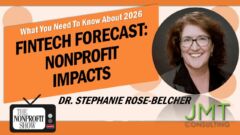
Nonprofit financial leaders are being asked to do more with less, manage rising risk, and still advance mission with confidence. Dr. Stephanie Rose-Belcher, COO of JMT Consulting, provides a forward-looking conversation on FinTech forecasts and what nonprofit executives must be preparing for now.
Dr. Rose-Belcher reframes finance as the operational backbone of nonprofit leadership, not a barrier. She opens by addressing cybersecurity, urging leaders to view it as a governance, compliance, and financial responsibility rather than an IT task. “This is not an IT issue. This is an everybody issue,” she explains, placing accountability squarely with executive leadership and boards. With donor data, financial systems, and integrated platforms increasingly interconnected, leaders must treat cyber readiness as an enterprise-wide business risk.
From there, the discussion moves to platform strategy. Rather than promoting a one-size-fits-all solution, Dr. Rose-Belcher challenges nonprofit leaders to take ownership of their technology ecosystem. The responsibility, she explains, is not simply to buy tools, but to understand workflows, integrations, return on investment, and the operational change required to realize value. Finance leaders, often serving as what she calls “accidental technologists,” must either develop this fluency or intentionally bring in expert guidance.
Predictive analytics emerges as a defining leadership capability for 2026. Dr. Rose-Belcher encourages nonprofit financial teams to move beyond static annual budgets toward rolling forecasts and scenario planning. By modeling funding shifts, cost changes, and operational risks throughout the year, finance teams can elevate their role from record-keeping to strategic decision support.
Talent constraints also surface as a pressing leadership challenge. With fewer trained accountants entering the field and nonprofit compensation pressures persisting, leaders must focus on skill development, retention, and creative workforce pipelines. Dr. Rose-Belcher shares how JMT is investing in long-term intern programs to strengthen the sector as a whole.
The episode closes with a powerful leadership message: finance teams must act as strategic partners and educators across the organization. “We consider finance the enabler of the mission, not the blocker,” Dr. Rose-Belcher notes—a mindset shift that can transform silos into shared stewardship.
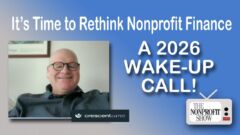
Keith Mestrich, Senior Advisor of Nonprofit and Foundation Partnerships at Crescent Cares, for a great nonprofit business conversation. As nonprofit leaders step into a new year filled with uncertainty and rapid change, Keith offers a clear message: finance isn’t a back-office function to tolerate—it’s one of the strongest tools a nonprofit has to stay steady, make smarter decisions, and keep programs moving when conditions shift.
Keith shares that early in his nonprofit CFO journey, he drew a firm line about how the role should operate: “As the CFO, I’m a full partner, just like any of your other programmatic partners are.” That idea sets the tone for the discussion. When finance is treated as an equal partner—connected to program strategy, staffing, and planning—leaders gain visibility into what’s possible, what’s risky, and what’s sustainable. Keith also explains why finance is often sidelined in the sector: many nonprofit executives rise through program excellence and suddenly inherit budgets, banking, insurance, and reporting—without ever being trained for the business mechanics.
From there, the conversation shifts to technology decisions that can protect both time and dollars. Keith uses a simple example that lands with almost every organization: paper checks. Moving payments and processes into modern systems can increase speed, reduce cost, strengthen tracking, and lower exposure to fraud. He also points to the growing potential of analytical tools and AI to strengthen forecasting—helping leaders anticipate cash-flow pinch points and plan ahead instead of reacting late.
Scenario planning becomes another centerpiece, and Keith keeps it approachable: you don’t have to create a plan for every possible situation. Focus on two major categories—key personnel changes and major financial impacts—and walk through what you would do if something shifted quickly. He emphasizes that this is a management responsibility, while boards should ensure it’s happening and revisited regularly.
Finally, Keith reframes risk management as something that supports confident leadership, not fear. As he puts it, “The bad guys know that our sector isn’t as sharp… They target us.” Reviewing insurance, cyber readiness, and coverage levels isn’t glamorous—but it’s part of protecting the mission with the same care you bring to programs.
#TheNonprofitShow #Nonprofitboards #NonprofitFinance
Why don’t nonprofit boards do their work — and what can executive leaders actually do about it? In this episode we welcome back executive coach, author, and speaker Hardy Smith, creator of the Amazon bestseller Stop the Nonprofit Board Blame Game. Hardy tackles the question nonprofit leaders lose sleep over: when boards underperform, is the problem really “the board”… or the way we build the board?
Hardy makes a bold case that disengagement often starts long before the first meeting — in recruitment that’s rushed, vague, and driven by panic. Too many organizations wait until seats are empty and the annual meeting is looming, then scramble to fill slots with “busy, well-known names” without real vetting or alignment. The result? Board members who cannot prioritize your mission, and leaders frustrated that nothing changes.
From there, Hardy goes straight to the business mechanics of governance: expectations, clarity, and accountability. If fundraising is part of board service, say it early. If meeting attendance matters, define it. If board members are being recruited for their influence, then design roles that actually use their influence. Hardy warns that when organizations avoid the “money talk” out of fear, they create a trust gap that’s hard to repair: “That’s called bait and switch. And it’s illegal.”
Most importantly, Hardy explains what makes great board members shut down: a board experience that wastes time. His prescription is practical and board-chair-ready—make meetings matter by structuring them around strategic progress, decision-making, and real conversation, not passive report approval. And if you want board ownership, involve them in the plan from the beginning—because as Hardy reminds us, “If they help bake the cake, they own the cake.”
Ready to stop blaming and start building a board that performs? This episode gives you a playbook to recruit with purpose, set expectations with confidence, and design meetings that earn engagement.
Organizational assessments can sound intimidating—like a test, a grade, or a “gotcha.” We sit down with Joan Brown, Chief Operations Officer at Third Sector Company, to reframe assessments as one of the smartest business moves a nonprofit can make—especially during leadership transition.
Joan explains that a strong organizational assessment is not about blame. It’s a systematic look at operations, performance, systems, and culture to answer one question: Are we operating in the best possible way to serve our mission? The real value is that it creates clarity and alignment across the organization—so decisions can be made with facts, not feelings or assumptions.
This conversation is especially timely for boards and leaders navigating an interim period. Joan shares why assessment belongs at the top of the interim playbook: it builds a shared reality of where the organization truly stands. And that shared reality becomes the foundation for priorities, staffing decisions, resource deployment, and even a far more accurate CEO/ED job description—particularly after a long-term “legacy leader” has held an outsized set of responsibilities for years.
You’ll also hear the nuanced difference between transitions when a beloved CEO departs versus when a leader has been let go: in one case, people may defend the past; in the other, emotion can flood the process. Either way, a transparent and participatory assessment helps separate noise from truth and turns tension into forward motion.
Joan says it best: “The main goal of the assessment process is shared reality.” When nonprofits build that shared reality early—using data, participation, and transparency—they gain the power to prioritize confidently, stabilize culture, and position the next leader for success.
If your board is preparing for leadership change, facing recurring “fires,” or simply wants better decisions with limited resources—this episode is your push to start the assessment conversation now.

What if the biggest thing holding your nonprofit back isn’t budget, bandwidth, or the board… but the size of the goal itself?
In this energizing conversation, Julia C. Patrick turns the spotlight inward for a rare public coaching session with Keith Ellis, “The Impossible Success Coach.” Together they tackle a leadership problem every nonprofit executive and development team knows too well: the endless list of “important” goals that leaves you busy, stressed, and still frustrated come October.
Keith’s premise is bold: stop aiming for incremental wins and start committing to the goal you genuinely believe you can’t reach — the one you keep dismissing because it feels out of reach. Why? Because “normal” goals create too many options. If your organization wants to raise 20% more this year, you can name 1,000 tactics… and you’ll spend the year guessing which ones matter most. But when you pursue a truly audacious target, the noise fades fast. Suddenly, there are only one or two moves that can realistically change the outcome — and your operational strategy gets clean, focused, and decisive.
The conversation also goes straight at board dynamics. Julia asks the question every nonprofit leader has whispered after a board meeting: how do you keep governance from chasing shiny objects? Keith reframes it as leadership sales: connect the vision to what board members already want, then “herd the cats” toward one clear, motivating aim that’s bigger than everyone’s comfort zone.
Most powerful: the episode redefines success as more than results. Keith argues the real payoff is who you become while building the capacity to achieve the goal — and that’s exactly how nonprofits scale beyond last year’s limits.
“If you set an impossible goal, it’s actually easier to achieve than a normal goal.” — Keith Ellis

If your nonprofit is staring at a funding gap in 2026: your money problem may actually be a structure problem. Host Julia C. Patrick welcomes Dr. Sharon Elefant of The Nonprofit Plug to talk about why grants and big gifts don’t “save” organizations when the foundation underneath is shaky—things like weak financial controls, unclear governance, founder-centric operations, burnout, and stalled growth.
Dr. Elefant frames it in plain language: when infrastructure is messy, even good funding becomes risky. She shares a real example of a funder walking into a site and asking, “What would you do with $100,000?”—and the leader couldn’t answer beyond “I need a million.” That moment exposes a common challenge: passion without business readiness. As Dr. Elefant puts it, “Funders don’t fund passion. They fund systems… impact… data… proven methodologies.” The practical shift starts with smaller, sharper thinking: her team asks clients, “What would you do with $5,000?” so leaders can articulate spending with purpose and credibility.
The duo then connects the dots to the daily realities nonprofit leaders face—grant reporting, accounting requirements, staffing ramps, and the inevitable pressure of post-award management, reminding viewers that grant dollars aren’t free; they demand operational strength. Together, they push the conversation toward healthier revenue design: Dr. Elefant suggests keeping grants to a manageable slice (she’s comfortable around 25%) and building the remaining 75% through stronger revenue streams like major donors, sponsorships, partnerships, and especially program service revenue. She normalizes earned income with examples nonprofits already recognize—hospitals, daycares, universities—and shows how fees can expand access through sliding scales and subsidized services.
The episode lands on relationships and board performance: cultivate funders like humans, ask them what they want, and bring mindset training to the boardroom with clear expectations, accountability, and the courage to treat board service like real work. Sustainable funding follows sustainable operations!
Founder syndrome gets tossed around like a diagnosis, but this conversation reframes it as a leadership and governance challenge that shows up in real nonprofit operations: decision rights, communication, accountability, and the organization’s ability to scale beyond one person’s willpower.
Guest Brittan Stockert (Donorbox) opens by rejecting the blame-heavy tone of the phrase and naming the real risk: “Founder syndrome is really when… you treat your nonprofit as if it’s yours personally… as opposed to something that you’re caring for on behalf of the people it’s serving.” From there, she maps how the issue can quietly spread through an organization: communication gaps, staff checking out, hesitation to propose new initiatives because leadership might swoop in, and small delays that snowball into major financial consequences. When reimbursable grants are submitted late, when board decisions stall, when donor communications feel inconsistent, funders and supporters notice. The result isn’t just drama it’s revenue disruption, talent loss, and the evaporation of institutional memory.
A valuable and thought-provoking conversation with Carrie Wright, consultant and coach at Wright Consulting. Joined by cohosts Julia C. Patrick and Wendy F. Adams, Carrie guides leaders toward a more thoughtful, rigorous, and human-centered approach to nonprofit organizational performance.
Rather than rushing into resolutions and planning cycles, Carrie urges leaders to adopt a practice of year-end reflection—an intentional look backward before charting the year ahead. As she states, “There’s a saying that ignorance is bliss, but I genuinely believe that knowledge is power.” That philosophy becomes the cornerstone of her framework: understand what fueled the team, what depleted it, and what priorities still belong at the table.
Carrie challenges organizations to treat mission, vision, and values not as decorative phrases, but as practical tools that recalibrate purpose. When teams drift from their “why,” burnout rises and cohesion dissolves. One method she employs is asking every team member to restate the mission in their own words and connect it directly to their daily responsibilities. This creates clarity, alignment, and ultimately ownership—an essential sequence for high-performing teams.
Quarterly rhythms also play a central role in Carrie’s approach. Instead of waiting an entire year to revisit goals or assess team health, she encourages predictable check-ins, extended conversations, and off-site sessions where challenges, ideas, and wins can surface in psychologically safe ways. These rhythms reduce confusion, prevent moving targets, and strengthen trust through consistency.
Carrie also emphasizes leadership development at every level. With her mantra, “Lead from where you sit,” she reframes leadership as an act accessible to all staff—not a title. This perspective urges team members to examine their habits, define one development goal, and consider what needs to be eliminated, automated, or delegated to make true progress.
Finally, she offers a compelling metaphor: culture as a thermostat—not something you set and ignore, but something requiring constant monitoring. Pulse checks, real communication, and people-first decisions are essential to preventing turnover and maintaining momentum.
With clarity, warmth, and strategic depth, Carrie presents a blueprint for nonprofits seeking resilience and alignment in the year ahead.
#TheNonprofitShow #NonprofitLeadership #TeamCulture