The Nonprofit Show is the nation’s daily live video broadcast for the business of nonprofits — where nonprofit leaders, teams, and changemakers gain practical strategies to strengthen operations, improve performance, and sustain impact.
Each weekday, our Co-hosts and expert guests tackle the most current topics in fundraising, management, marketing, staffing, and technology — all designed to help you run smarter, lead stronger, and deliver on your mission with confidence.
Join our community of nonprofit professionals and explore the real tools and insights you need to build a high-performing organization.
Watch Live. Learn Daily. Lead Better!
Monday thru Friday
Sign-up for Show Reminders!
Meet Our Co-hosts!

Made Possible By Our Generous Education Partners Who Support And Believe In The Work You Do

OUR LEARNING LIBRARY WITH MORE THAN 1,500 EPISODES!
MEET SOME OF OUR RECENT GUESTS AND EXPERTS
Nonprofit leadership coaching ROI isn’t about feel-good conversations—it’s about measurable performance, accountability, and organizational alignment that drives real results. Wendy F. Adams, CFRE and CEO of Cultivate for Good, breaks down what coaching actually delivers for nonprofit leaders—and why many organizations misunderstand its value. From executive directors to development leaders, coaching is not a luxury—it’s a strategic tool for improving leadership effectiveness and organizational outcomes.
Wendy emphasizes that leadership is the starting point for all impact: “Where the leader goes, there goes the organization.” Without alignment at the top, teams stall, cultures fracture, and missions drift. Coaching helps leaders identify blind spots, clarify priorities, and move from insight to action.

This episode challenges fundraisers to keep pace with rapid shifts in donor expectations, technology, and data-driven decision-making. It explores how professional development, transparency, and modern strategies are essential for long-term nonprofit success.

How nonprofits can use data for decision making starts with a simple shift: recognizing that data is just information you already have. In this episode, Dr. T’Ping Westbrook and Dr. Allison K. Holmes break down how nonprofit leaders can move from confusion to clarity by using data as a strategic tool—not a reporting burden.
For many organizations, data feels overwhelming, technical, or even intimidating. But as Dr. Westbrook explains, “Data is information. If you have information, you have data.” This powerful reframe removes the barrier and puts nonprofits back in control of their decision-making.
The conversation challenges a common mistake across the sector—collecting data primarily to satisfy funders instead of strengthening internal strategy. Instead, the guests emphasize starting with a critical question: what information do you actually need to run your organization effectively?
From there, nonprofit leaders can begin building a data-driven culture grounded in clarity, shared language, and purpose. Organizations that succeed in this space align their teams around a common understanding of their work, ensuring that data is accessible, relevant, and actionable across departments.

This episode explores how nonprofits can fix fragmented data systems by centralizing information, improving reporting, and building scalable infrastructure that supports growth and better decision-making. A strong nonprofit data management strategy is no longer optional—it’s essential for scaling impact, improving reporting, and saving valuable staff time.
Cherry Yang, CEO of Claribase and an award-winning Airtable consultant, shares how nonprofits can move from fragmented systems and spreadsheet overload to centralized, scalable data operations. If your team is constantly switching tools, copying and pasting data, or struggling to produce reports, this conversation offers a clear path forward.
Cherry explains why most nonprofit systems fail: they operate in silos. Fundraising platforms, program data, financial tools, and spreadsheets often live separately—creating inefficiencies and increasing risk. As she notes, “People end up doing a lot of copy and pasting… and it just doesn’t work. It’s not efficient, and people waste so much time.”
Instead, she advocates for centralized data systems that connect teams, automate workflows, and provide real-time dashboards for leadership. With the right structure, nonprofits can eliminate manual processes, reduce errors, and give decision-makers immediate access to insights.

Nonprofit payroll is no longer just administrative—it’s a strategic function tied to compliance, retention, and funding transparency. This episode breaks down the key risks and opportunities leaders must manage to protect and scale their organizations.

Exploring how nonprofits can build a seamless donor journey strategy by integrating earned revenue, audience experience, and long-term philanthropic engagement. A strong nonprofit donor journey strategy connects every touchpoint—from first interaction to long-term giving. Dr. Jonathon Scott Crider of Fox Tucson Theatre shares how integrating earned revenue, audience experience, and philanthropy can transform financial sustainability for nonprofits.
For organizations balancing mission delivery with revenue realities, this conversation highlights a critical truth: “This organization has to sell tickets in order to fulfill its mission.” Ticket sales drive engagement, but they are only the beginning. The real opportunity lies in what happens next.
Jonathon outlines how his team manages the full continuum—from awareness to ticket purchase, live experience, and ultimately donor cultivation. Rather than separating marketing and development, they treat every attendee as a potential long-term supporter. This unified approach allows them to grow both earned and contributed revenue simultaneously.
One of the most powerful takeaways challenges traditional fundraising assumptions. Many nonprofits focus heavily on high-capacity donors, but Jonathon emphasizes that loyalty may be the most overlooked asset: “You’re leaving money on the table when you’re not talking to people who’ve just been loyal to you.” Consistent, modest donors often represent strong planned giving prospects because of their sustained connection to the mission.
The episode also introduces practical strategies like identifying “super fans”—high-frequency participants who can become key donors—and aligning programming decisions with sponsorship opportunities. By connecting experiences directly to funding, nonprofits can create a more predictable and engaged revenue model.
For nonprofit leaders, this conversation reinforces a critical operational mindset: every interaction is part of the donor journey. When organizations intentionally design that journey, they unlock deeper engagement, stronger loyalty, and more sustainable growth.
#TheNonprofitShow #NonprofitStrategy #Fundraising

The nonprofit development assistant role responsibilities are often misunderstood—but getting this position right can dramatically increase fundraising results and operational efficiency.
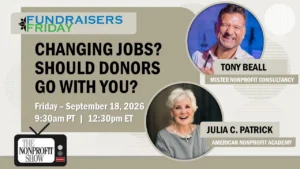
In this Fundraisers Friday episode, Julia Patrick and Tony Beall break down why this role is not just administrative support—but a strategic investment that frees your fundraising team to focus on revenue generation, donor relationships, and long-term growth.
As Tony explains, “Nonprofit fundraising professionals need to have the bandwidth to be away from their desk… making connections and stewarding relationships.” Without that support, highly paid development leaders end up doing low-value administrative work—limiting your organization’s return on investment.
This conversation dives into the real responsibilities behind the role, including donor database management, acknowledgments, reporting, event coordination, CRM oversight, and campaign support. These are not small tasks—they are the operational backbone of effective fundraising.
Julia highlights a critical mindset shift: “Even just opening your heart and your mind to having this support might be a little bit of a challenge.” Many organizations—and even development professionals—struggle to delegate, which creates bottlenecks and slows growth.
You’ll also learn:
When a nonprofit should consider hiring a development assistant
How to structure the role (full-time, part-time, or shared)
Why customer service skills are essential in fundraising operations
How this role supports donor experience and retention
Career pathways and talent pipelines (including interns and volunteers)
Most importantly, this episode challenges nonprofit leaders to think in terms of time value and ROI—are your highest-paid fundraisers doing the work that actually drives revenue?
If your organization is serious about scaling fundraising and improving efficiency, this is a conversation you need to hear.
#TheNonprofitShow #NonprofitLeadership #FundraisingStrategy

If your nonprofit’s strategic plan is sitting on a shelf instead of driving results, this conversation is your wake-up call. Dylan Bassett, Principal and Founder of Department 1 Solutions, challenges a deeply ingrained habit across the sector: setting ambitious goals without first understanding operational capacity.
Dylan makes it clear—most nonprofit plans fail not because of poor intentions, but because they are disconnected from the realities of staff bandwidth, systems, and workflows. As he explains, “A lot of nonprofit strategic plans are too big for the team that’s executing them.” That disconnect creates frustration, burnout, and ultimately stalled progress.
Instead of starting with lofty goals, Dylan urges organizations to flip the model. Begin by assessing what your team and technology can actually support today. Then identify the gap between current capacity and future ambitions. That gap becomes the real work—where systems, processes, and people must align.
A major takeaway? Many nonprofits already have the tools they need but are underutilizing them. Rather than rushing to purchase new platforms, leaders should first uate how existing systems can be better configured and adopted. This approach not only saves money but also strengthens internal efficiency.
Dylan also emphasizes turning strategy into a daily habit. By breaking large goals into smaller, measurable actions, organizations can maintain momentum, build team confidence, and create regular opportunities for progress. As he shares, “The success of success is the sum of small efforts repeated day in and day out.”
This is more than a planning conversation—it’s a call to rethink how your organization operates. Bring your team into the process. Align your tools with your workflows. And most importantly, create a roadmap that your staff can actually execute.
If your nonprofit is ready to move from planning to performance, this episode is your next step.
#TheNonprofitShow #NonprofitStrategy #OperationalExcellence

Emotion drives giving; nonprofits must align with donor intent. a sophisticated and deeply reflective conversation on the science behind donor decision-making from Cherian Koshy. Drawing from neuroscience and behavioral research, Cherian reframes fundraising not as persuasion, but as understanding—an evolution that has profound implications for the business of nonprofits.
Cherian shares his own journey into fundraising, describing how early trial-and-error efforts led him to question a fundamental issue: why do donors give? That curiosity sparked a deeper exploration into human behavior, ultimately revealing that giving is not driven primarily by logic, but by emotion. As he explains, “We make the emotional decision… and then our brain says, how do I justify or rationalize that decision based upon proof.”
This insight challenges long-held assumptions in nonprofit strategy. Rather than focusing solely on rational appeals or comparative value, organizations must recognize that donors are already motivated by internal emotional drivers. The fundraiser’s role, Cherian emphasizes, is not to convince, but to facilitate: “Our job as fundraisers is actually to get out of their way… not to convince them to do something that they don’t want to do.”
The discussion also confronts ethical considerations, particularly as technology and AI reshape the sector. Cherian introduces a practical ethical framework: if a donor would feel uncomfortable knowing how their behavior is being influenced, the approach is likely inappropriate. Transparency, consent, and donor intent become essential guardrails.
Importantly, the conversation bridges theory with application. From simplifying donation processes to rethinking stewardship messaging, Cherian illustrates how neuroscience can strengthen donor relationships when used responsibly. His example of moving from transactional acknowledgments to emotionally resonant gratitude reveals a powerful truth: donors are not giving to organizations—they are expressing personal meaning.
As nonprofits face increasing pressure to perform, this episode offers a refined perspective on sustainable fundraising, inviting leaders to move beyond tactics and toward a more human-centered, ethically grounded approach that builds long-term trust and impact.
#TheNonprofitShow #FundraisingStrategy #DonorBehavior cherian koshy

Smarter gala strategy can grow revenue and donor loyalty. Nonprofits can turn fundraising events into more efficient, donor-friendly, revenue-generating experiences that support long-term growth. Most events are full of potential, but this learning session makes it clear that the strongest galas are no longer built around chaos, long lines, and overworked staff.
In this energizing conversation, Justin Goodhew, Co-Founder and CEO of Trellis, makes the case that event success is not just about what happens in the ballroom. It starts before the event with better use of donor data, stronger integration with internal systems, and smarter choices about where staff time should go. He explains that many organizations stop doing galas not because events no longer matter, but because the process drains team capacity. By simplifying check-in, reducing friction, and using technology that connects with existing CRM and finance systems, nonprofits can free staff and volunteers to focus on donor relationships rather than administrative bottlenecks.
He also brings a strong business lens to revenue strategy. Instead of piling on low-yield activities that consume time, Justin encourages nonprofits to focus on the highest net return, such as paddle raises, major auction items, and thoughtfully designed upsell options. As he puts it, “We’re actually really a fundraising and a donor retention platform disguised as an event platform.” That perspective shifts the conversation from event logistics to donor value and lifetime engagement.
One of the key takeaways is Justin’s emphasis on what happens after the event. Fast follow-up, integrated donor data, and immediate action are what turn a one-night attendee into a future supporter. He also shares that strategic auction upsells can produce “about 6 to 7% increase in revenue” simply by giving donors another easy, mission-aligned way to give.
This session is a smart reminder that nonprofit events do not need to disappear. They need to evolve. With the right systems, intentional design, and a stronger focus on donor experience, galas can become more productive, more profitable, and far more sustainable for nonprofit teams!
#TheNonprofitShow #NonprofitFundraising #EventStrategy

Second-home donors are a powerful and overlooked giving audience. Second-home ownership may sound like a lifestyle topic, but this episode makes it clear that it is also a major nonprofit business opportunity. Jeffrey Glebocki, Founder and Lead Advisor of Strategy Plus Action Philanthropy, shares first-of-its-kind research on how second homeowners think, give, volunteer, and connect with causes in the communities where they spend part of the year. The scale alone is eye-opening. Jeff explains that there are about 6.5 million second homes in the United States, representing roughly 5% of the nation’s housing stock. Even more striking, half of those second homes are concentrated in just eight states: Florida, California, New York, Texas, Michigan, North Carolina, Arizona, and Pennsylvania. For nonprofits operating in these areas, this is not a niche audience. It is a significant and often underused segment of philanthropic opportunity!
Jeff explains that second-home owners bring substantial giving capacity. Their liquid available assets ranged from $250,000 to more than $100 million. More importantly, they are not simply passive residents. Many are interested in building relationships, finding meaning, and supporting local organizations once they feel connected to the place. That connection usually takes time. According to the research, donors often wait two to three years before making gifts in their second-home communities, but once engaged, they can become generous supporters, volunteers, and even board members.
One of the most exciting takeaways is that these donors are not looking for a hard sell. They respond to invitations from trusted people, easy entry points, and meaningful social experiences. Jeff puts it plainly: “If we don't know about you, if we don't hear about your group or your cause, we can't give to you.” That insight alone is a wake-up call for nonprofits that want to expand their visibility and strengthen local communications.
The lively conversation also reveals that donor values tend to remain steady across both primary and second-home communities. Yet donors often adapt their giving to local realities, whether that means environmental concerns, housing pressures, disaster response, or border issues. As one donor quoted in the research said, “Our money here has more impact, period.” That sense of direct, visible results can deepen trust and grow long-term support.
This is a smart, practical conversation about donor behavior, local engagement, and how nonprofits can better position themselves to welcome a high-capacity audience already living among them part of the year.
#TheNonprofitShow #Philanthropy #FundraisingStrategy

Donor retention is a measurable strategy, not just a fundraising hope. Plus, how to calculate donor retention for nonprofits. On this episode of Fundraisers Friday, Julia Patrick and Tony Beall take on one of the most serious business challenges in the nonprofit sector: donor retention. Their conversation makes clear how fundraising success is not only about bringing in new names, it’s about keeping the people who have already said yes to your mission and building systems that help them stay connected.
The discussion begins with a hard truth: average donor retention is far too low, and many organizations are not even measuring it consistently. Julia frames the issue in plain terms, calling it “a crisis,” while Tony brings context by showing how retention can vary by subsector. Faith-based groups and higher education may see stronger rates, while arts, culture, and human services organizations often face a steeper climb. That contrast alone reminds nonprofit leaders that benchmarking matters, but strategy matters even more.
One of the most focused parts of their conversation is the simple donor retention formula. Julia makes the case that this number belongs in board meetings, CEO reports, and regular management conversations. Retention is not a side note. It is a core operating measure. As she puts it, “It should be present with everyone so that you know what is going on.”
Tony then moves the conversation from math to management. He explains that donors leave for understandable reasons: delayed thanks, weak impact reporting, too many asks, and too little human connection. His line captures the heart of the episode: “We’re not talking about transactional fundraising. We’re talking about relationship-driven fundraising.” That idea turns donor retention from a development task into an organizational discipline.
They also link retention to stewardship cost, long-term donor growth, monthly giving, and next-generation philanthropy. Monthly donors, in particular, are shown as a promising path for building a more stable base. Julia and Tony encourage leaders to study patterns, review donor journeys, and make practical choices with limited resources.
#TheNonprofitShow #FundraisersFriday #DonorRetention